Walkthrough: CNCF Bingo, 24 Phones, 15 Calls and Three Unofficial Bingo Masters
On November 10, at Cloud Native University in the Cloud Native Theater at KubeCon + CloudNativeCon North America 2026 in Salt Lake City, I ran a lightning talk that was a game of bingo. No slides of logos, no feature lists. The room scanned a QR code, got a bingo card of real CNCF projects on their phones, and I read clues out loud.
Play it yourself: https://bingo.michaelrishiforrester.com
The problem it was built for
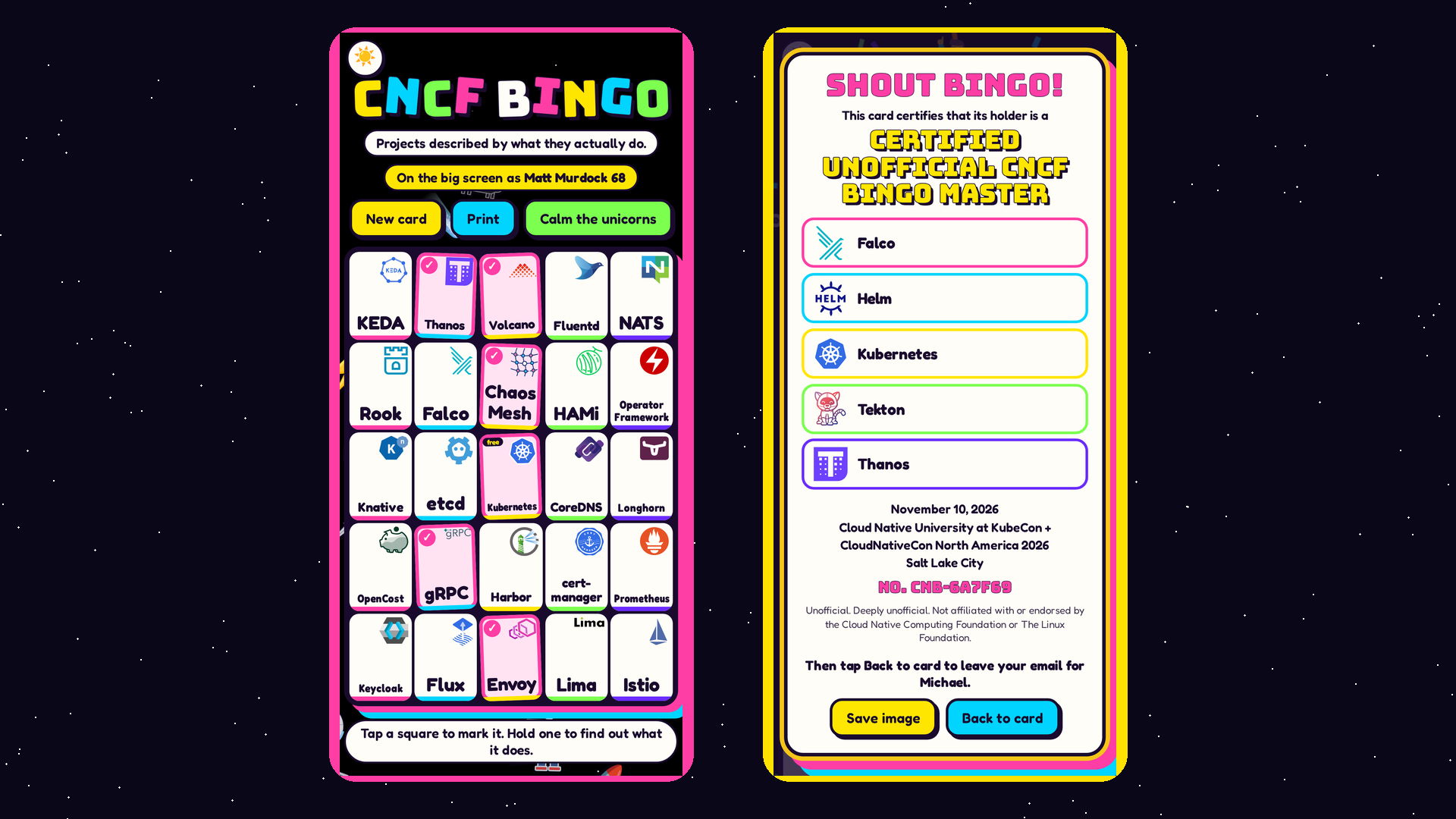
The CNCF landscape is big enough that most people at KubeCon know a handful of projects well and recognize the rest by logo. Names don't tell you much. "Volcano", "Harbor" and "Thanos" could be anything. So every call in CNCF Bingo is three plain clues, broad to specific, and the last one is always "We use this for ___", said the way the community says it. No clue names the project or uses a word from its name, and every fact comes from the project's own pages. To mark a square, you have to know what the project does.
How the room played
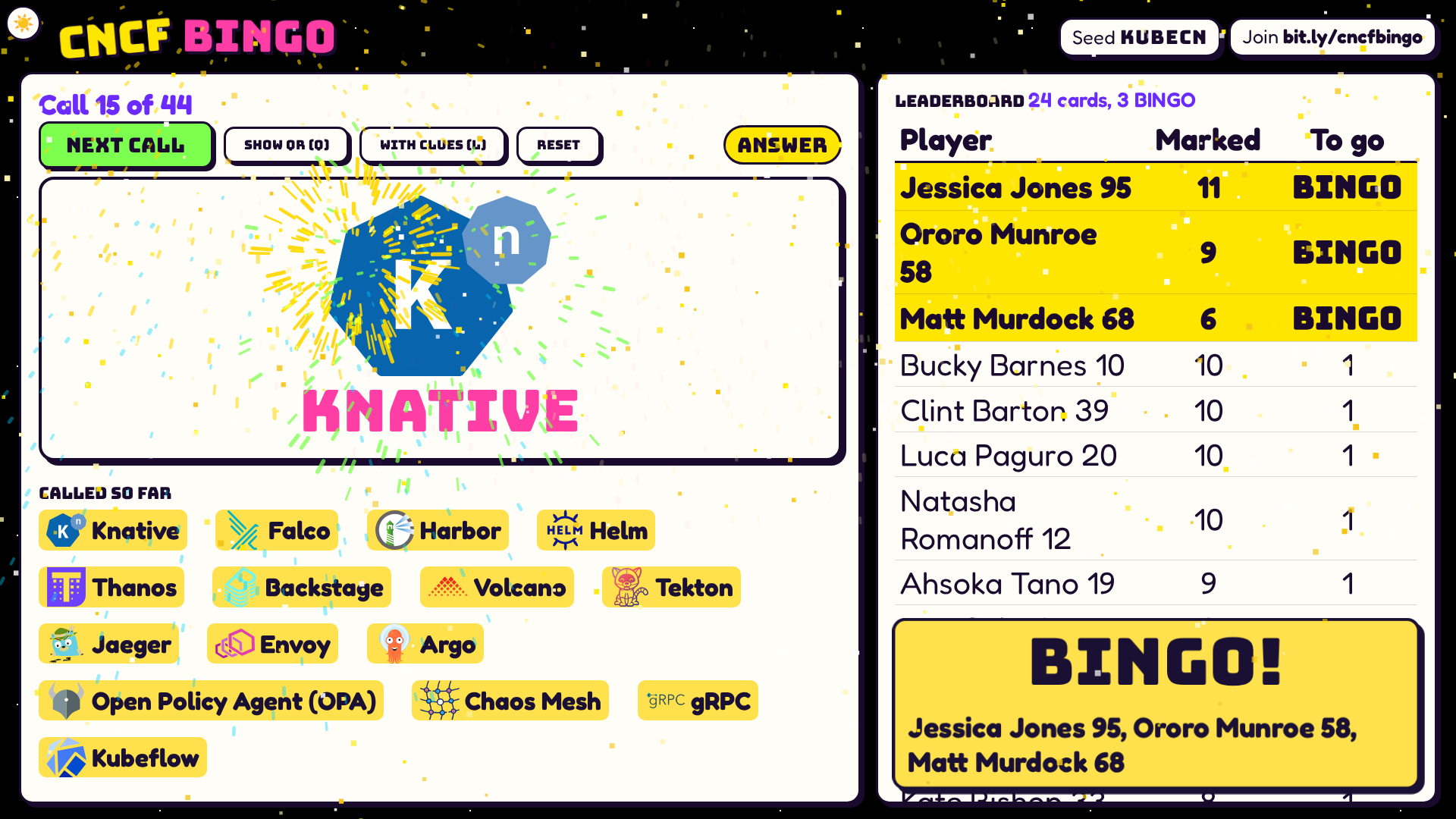
The room went from 2 cards to 19 in about two minutes while I was still saying hello, and peaked at 24 phones. Each card got a Disney character name on the big screen, so nobody typed anything and nobody's real name went up on a projector. The leaderboard on the host screen showed how many squares each card had to go, and that is what makes a room lean forward. A minute before the first BINGO, six of the 23 cards still in play were one square away. A minute after it, nine were.
Then three BINGOs landed inside 83 seconds:
- Matt Murdock 68, on call 13 (Harbor), with six marks.
- Ororo Munroe 58, on call 14 (Falco). That was Danielle Cook, one of the Cloud Native University organizers. Even organizers can win.
- Jessica Jones 95, on call 15 (Knative).
Each winner's phone turned into a certificate naming them a Certified Unofficial CNCF Bingo Master, listing the five projects on their winning line. Deeply unofficial, and that is the whole prize: bragging rights.
The projects we called
In order: Kubeflow, gRPC, Chaos Mesh, Open Policy Agent (OPA), Argo, Envoy, Jaeger, Tekton, Volcano, Backstage, Thanos, Helm, Harbor, Falco and Knative. Kubernetes was the free space, because of course it was.
The full call pool is 44 projects, 28 graduated and 16 incubating, so most cards still had plenty of unplayed squares when we stopped.
What worked, and what took the most work
The phones. People expect a conference game to be a printout or a web form. This one was a live card: tap a square when you know the answer, hold a square to find out what the project does, and the host screen sees your progress in real time. Every card counts a mark only if it was made after that project was called, so you can't pre-tap a line and shout BINGO.
The pacing took more work than the app. With an unknown room size, a game can end on the fourth call or never end at all inside a twelve-minute slot. The cards handed out in the session were dealt from a deck chosen against the session's call order, so whatever the turnout, the first winners would arrive in the middle of the talk and only a few at a time. With 24 people, the plan said up to five winners by call 15. We got three.
The rehearsals mattered more than any feature. I rehearsed it several times with rooms of simulated phones playing against the live site, which is how I found the bug that would have shown up on stage: 38 bots that joined a room right after a speed run inherited its list of calls, which made their cards claim BINGOs they had not earned before the first call. The relay now clears that list when the host leaves.
Keep playing
The site is still up, and it has more than the bingo card. There are practice games built on every active CNCF project, 227 of them, not only the 44 on the cards:
- Flashcards: two clues on the front, the project on the back.
- Who am I?: one clue at a time, with more points for naming the project early.
- Logo match: pair each logo with what we use it for.
They store nothing and need no account. If you are studying for KCNA or just want to stop nodding along when someone says "we moved to Backstage", they are a good fifteen minutes.
https://bingo.michaelrishiforrester.com/games
Thank you to Danielle Cook and Simon Forster for having CNCF Bingo at Cloud Native University, and to everyone in the Cloud Native Theater who scanned a code and played along. CNCF Bingo is ready to come back for the next KubeCon, themed for AI, storage or whatever the room wants to learn.